

You'd be pretty excited too, if you bought a lot of 1998-2000 Stadium Club Triumvirate/3X3's for only $22.
Showing posts with label 1999. Show all posts
Showing posts with label 1999. Show all posts
Thursday, July 07, 2016

Friday, October 24, 2008
Video Box Break and Review: 1999 Upper Deck PowerDeck
This waxbox sent to me by Russ from The House of Cardboard for winning the baseball card bloggers fantasy league. So far, he's the sole person to send me my winnings.
One box of 1999 Upper Deck PowerDeck
24 packs per box, two paper cards (a.k.a. "Auxiliaries") plus one baseball card sized CD-ROM per pack.
The Video
The Pulls
Base Set
CD-ROMS: 18 of 25 (72.00%)
Auxiliaries: 24 of 25 (96.00%)
13 Doubles
3 Triples
2 Quads
Inserts
CD-ROMS
1 Season to Remember (One CD-Rom, packaged as a chiptopper) M. McGwire
4 Powerful Moments (Six CD-Roms, 1:7) S.Sosa, C. Ripken, Jr., K. Griffey, Jr., A-ROD
1 Time Capsule (Six CD-Roms, 1:23) K. Griffey, Jr.
Auxiliaries
3 Powerful Moments (Six Cards, 1:7) D. Jeter, A-Rod (2)
1 Time Capsule (Six cards, 1:23) NOE-MAH!!!
Parallels: NONE
Autogamers: NONE
The Review
1999 Upper Deck PowerDeck was one of the more, shall we say, unique baseball card sets ever made. PowerDeck is a product that revolves not around baseball cards, but baseball CD-ROMs. Each three "card" pack contained two regular baseball cards (or "Auxiliaries" as UD calls them here) and a CD-ROM die-cut to the size of a standard-sized trading card.
The concept of merging the traditional, humble baseball card, with the technology of the day, was nothing new. In 1962 and again in '64, Columbia Records in association with the makers of Milk Duds candy, issued a set called Auravsion which featured the images of baseball players pressed onto 33 1/3 RPM records. When placed on a turntable, each Auravision "card" played a brief interview with the subject. Earlier in the 90s, both Topps and Donruss experimented with CD-ROM-based trading card products of their own (Cybr Cards and VxP, respectively). And in a way, Topps' new social networking website Topps Town continues this convergence of technology and cardboard.
'99 PowerDeck was not Upper Deck's first experiment with a cyber-savvy trading card. A year earlier it randomly inserted into specially marked packs of 1998 Series One an audio CD die-cut to the size of a trading card. Collectors who received this "card" could then mount it onto a special tray that was packed as a chiptopper into each waxbox, insert the tray into any CD player, and hear a five-minute interview of UD spokesjock Ken Griffey, Jr.
By 1999 the technology had advanced enough to include video as well as audio onto these CD-ROMs and UD felt the time was right for a stand-alone PowerDeck product.
The base set consisted of only 25 CD-ROMs (one for each player), and each CD-ROM corresponds with a paper-based Auxiliary (i.e. Card and CD-ROM #1 in both sets is Ken Griffey, Jr.; #2 is Mark McGwire; and so on). The same is true for each of the three different insert sets.
Each CD-ROM has game clips, sounds, photos, and sortable career stats of the featured players -- which in 1999 (provided you had a Pentium-based rig with 133MHz, 12MB of RAM, a 4X CD-ROM drive and a Sound Blaster compatible sound card) was cutting edge. Popping a few of these into my laptop, it seems almost Precambrian.
The PowerDeck concept never really caught on, although the suggested retail price of $5/pack may have had a little something to do with it's failure. And although a second series of PowerDecks was released in 2000, UD has yet to issue another.
The Bottom Line
Collation was par-for-the-course with most late 90s UD products -- that is, dreadful. I received two copies of the same Alex Rodriguez Powerful Moments Auxiliary insert, and four copies each of Mo Vaughn and Chipper Jones' Auxiliary base cards.
If you're looking for something different to bust, and don't want to spend a lot of money, then try a box of 1999 Upper Deck PowerDeck. You can bust worse.
Box Rating: 2 Gumsticks (out of five)
Product Rating: 2 1/2 Gumsticks (out of five)
One box of 1999 Upper Deck PowerDeck
24 packs per box, two paper cards (a.k.a. "Auxiliaries") plus one baseball card sized CD-ROM per pack.
The Video
The Pulls
Base Set
CD-ROMS: 18 of 25 (72.00%)
Auxiliaries: 24 of 25 (96.00%)
13 Doubles
3 Triples
2 Quads
Inserts
CD-ROMS
1 Season to Remember (One CD-Rom, packaged as a chiptopper) M. McGwire
4 Powerful Moments (Six CD-Roms, 1:7) S.Sosa, C. Ripken, Jr., K. Griffey, Jr., A-ROD
1 Time Capsule (Six CD-Roms, 1:23) K. Griffey, Jr.
Auxiliaries
3 Powerful Moments (Six Cards, 1:7) D. Jeter, A-Rod (2)
1 Time Capsule (Six cards, 1:23) NOE-MAH!!!
Parallels: NONE
Autogamers: NONE
The Review
1999 Upper Deck PowerDeck was one of the more, shall we say, unique baseball card sets ever made. PowerDeck is a product that revolves not around baseball cards, but baseball CD-ROMs. Each three "card" pack contained two regular baseball cards (or "Auxiliaries" as UD calls them here) and a CD-ROM die-cut to the size of a standard-sized trading card.
The concept of merging the traditional, humble baseball card, with the technology of the day, was nothing new. In 1962 and again in '64, Columbia Records in association with the makers of Milk Duds candy, issued a set called Auravsion which featured the images of baseball players pressed onto 33 1/3 RPM records. When placed on a turntable, each Auravision "card" played a brief interview with the subject. Earlier in the 90s, both Topps and Donruss experimented with CD-ROM-based trading card products of their own (Cybr Cards and VxP, respectively). And in a way, Topps' new social networking website Topps Town continues this convergence of technology and cardboard.
'99 PowerDeck was not Upper Deck's first experiment with a cyber-savvy trading card. A year earlier it randomly inserted into specially marked packs of 1998 Series One an audio CD die-cut to the size of a trading card. Collectors who received this "card" could then mount it onto a special tray that was packed as a chiptopper into each waxbox, insert the tray into any CD player, and hear a five-minute interview of UD spokesjock Ken Griffey, Jr.
By 1999 the technology had advanced enough to include video as well as audio onto these CD-ROMs and UD felt the time was right for a stand-alone PowerDeck product.
The base set consisted of only 25 CD-ROMs (one for each player), and each CD-ROM corresponds with a paper-based Auxiliary (i.e. Card and CD-ROM #1 in both sets is Ken Griffey, Jr.; #2 is Mark McGwire; and so on). The same is true for each of the three different insert sets.
Each CD-ROM has game clips, sounds, photos, and sortable career stats of the featured players -- which in 1999 (provided you had a Pentium-based rig with 133MHz, 12MB of RAM, a 4X CD-ROM drive and a Sound Blaster compatible sound card) was cutting edge. Popping a few of these into my laptop, it seems almost Precambrian.
The PowerDeck concept never really caught on, although the suggested retail price of $5/pack may have had a little something to do with it's failure. And although a second series of PowerDecks was released in 2000, UD has yet to issue another.
The Bottom Line
Collation was par-for-the-course with most late 90s UD products -- that is, dreadful. I received two copies of the same Alex Rodriguez Powerful Moments Auxiliary insert, and four copies each of Mo Vaughn and Chipper Jones' Auxiliary base cards.
If you're looking for something different to bust, and don't want to spend a lot of money, then try a box of 1999 Upper Deck PowerDeck. You can bust worse.
Box Rating: 2 Gumsticks (out of five)
Product Rating: 2 1/2 Gumsticks (out of five)
Saturday, May 10, 2008
Vintage Video Box Break and Review: 1999 Skybox Metal Universe
One retail box of 1999 Skybox Metal Universe (paid $18.95 + shipping from Pittsburgh Sports Wholesale *)
20 packs per box, six cards per pack (MSRP $2.39)
The Details
Base Set: 300 cards
Parallels: NONE (all are Hobby Only)
Inserts:
15 Neophytes (1:10)
15 Boyz with the Wood (1:30)
15 Planet Metal (1:60)
15 Diamond Soul (1:96)
10 Linchpins (1:576)
Autogamers: NONE (all are Hobby Only)
The Pulls
Part One
Part Two
Base Set: 116 of 300 (38.67%)
Inserts:
2 Neophytes: P. Konerko, M. Tejada
1 Boyz with the Wood: M. Piazza
1 Planet Metal: D. Erstad
1999 Skybox Metal Universe was a set that I never got around to collecting. But when I ripped a pack of this in my recent 20-for-$40 gimmick on APAD, I was hooked. I made it my mission to bust a waxbox. Unfortunately, all I could find on Pittsburgh Sports Wholesale was this 20-pack retail box.
Like in previous years, all the base cards have etched-foil fronts and are embossed -- hence, the name. The 1999 Metals have an industrial look and feel, with what look like riveted iron plating. Unfortunately, they only added the embossing to the top-half of the card, which if stacked, causes a noticeable lean.

To wit: These are all the base cards I ripped from this box. I like to call this "The Leaning Tower of 1999 Metal."
Among the subsets, there are 25 "Building Blocks" (prospects and rookies), 25 "M.L.P.D.s" -- which I still have no idea what it stands for -- and 15 "Caught on the Fly's." What makes the subsets great -- but in an unintentionally funny kind of way -- are their backs. The COTF's are "written" in the style of the Sporting News column of the same name. But it's the Building Blocks and M.L.P.D. backs that are notable. Notable in their hilarity.
In the late-90s, Fleer oriented all their Skybox brands to appeal to an "urban" audience. (They even hired Coolio to star in their print ads.) This marketing/pandering even went as far as the language used on backs of the cards.
Before I go any further I should note that in September 2001 I had a job interview at Fleer's headquarters in Mt. Laurel, New Jersey. After spending nearly two hours at the Fleer office, I did not notice anyone outside the "middle-aged-white-guy/white-gal" demographic who was employed there. Please take this into consideration before reading the back of Adrian Beltre's Building Blocks card.
See what I mean?
The numbered-to-50 Precious Metal Gems and one-of-one Gem Master parallels were exclusive to Hobby, but all five non-parallel inserts were available in retail as well, albeit at slightly longer odds. Like the subsets, all the inserts are written in "Mount Laurel Ebonics." The fifteen card, 1:10/pack Neophytes are the designated "Hot Rookie" insert that was standard in most late-90s products. The fifteen card, 1:30 Boyz with the Wood (See, it's spelled with a "Z" at the end! It's gangsta!) are an equally formulaic "Power Hitters" insert. If these cards look a lot like those "Flapper" cards in this years Topps Opening Day, they should. The BwtW and the Opening Day Flappers were made by the company.
Planet Metal (1:60) is the standard issue die-cut insert and Diamond Soul (1:96) are lenticular (i.e. Sportflix) cards. In the era before the gamer, just about every Fleer set had one insert that was a genuinely tough pull. In 1999 Skybox Metal Universe, the 1:576/pack Linchpins -- which have a laser-cut cotter pin design in the background -- fit this bill.
The Bottom Line
For such a small box, (only 120 cards) I had some pretty good pulls. I only wish I had found a Hobby box though. I received almost 40% of the base set, two Neophytes inserts, a Mike Piazza Boyz with the Wood, and a one-per-third box Planet Metal of Darin Erstad.
Product Rating: 2 1/2 Gumsticks (out of five)
20 packs per box, six cards per pack (MSRP $2.39)
The Details
Base Set: 300 cards
Parallels: NONE (all are Hobby Only)
Inserts:
15 Neophytes (1:10)
15 Boyz with the Wood (1:30)
15 Planet Metal (1:60)
15 Diamond Soul (1:96)
10 Linchpins (1:576)
Autogamers: NONE (all are Hobby Only)
The Pulls
Part One
Part Two
Base Set: 116 of 300 (38.67%)
Inserts:
2 Neophytes: P. Konerko, M. Tejada
1 Boyz with the Wood: M. Piazza
1 Planet Metal: D. Erstad
1999 Skybox Metal Universe was a set that I never got around to collecting. But when I ripped a pack of this in my recent 20-for-$40 gimmick on APAD, I was hooked. I made it my mission to bust a waxbox. Unfortunately, all I could find on Pittsburgh Sports Wholesale was this 20-pack retail box.
Like in previous years, all the base cards have etched-foil fronts and are embossed -- hence, the name. The 1999 Metals have an industrial look and feel, with what look like riveted iron plating. Unfortunately, they only added the embossing to the top-half of the card, which if stacked, causes a noticeable lean.

To wit: These are all the base cards I ripped from this box. I like to call this "The Leaning Tower of 1999 Metal."
Among the subsets, there are 25 "Building Blocks" (prospects and rookies), 25 "M.L.P.D.s" -- which I still have no idea what it stands for -- and 15 "Caught on the Fly's." What makes the subsets great -- but in an unintentionally funny kind of way -- are their backs. The COTF's are "written" in the style of the Sporting News column of the same name. But it's the Building Blocks and M.L.P.D. backs that are notable. Notable in their hilarity.
In the late-90s, Fleer oriented all their Skybox brands to appeal to an "urban" audience. (They even hired Coolio to star in their print ads.) This marketing/pandering even went as far as the language used on backs of the cards.
Before I go any further I should note that in September 2001 I had a job interview at Fleer's headquarters in Mt. Laurel, New Jersey. After spending nearly two hours at the Fleer office, I did not notice anyone outside the "middle-aged-white-guy/white-gal" demographic who was employed there. Please take this into consideration before reading the back of Adrian Beltre's Building Blocks card.
"Yo, Adrian, 20 years old, filling in for Bobby Bo' at third for the L.A. Dodgers ... not bad. We know that you almost nabbed the '97 FSL Triple Crown and were Mr. MVP. We can see your glove is phat already. But at 20? I guess that's why Zeile's in Texas and Konerko's in Cincy ... your move, Kid."
See what I mean?
The numbered-to-50 Precious Metal Gems and one-of-one Gem Master parallels were exclusive to Hobby, but all five non-parallel inserts were available in retail as well, albeit at slightly longer odds. Like the subsets, all the inserts are written in "Mount Laurel Ebonics." The fifteen card, 1:10/pack Neophytes are the designated "Hot Rookie" insert that was standard in most late-90s products. The fifteen card, 1:30 Boyz with the Wood (See, it's spelled with a "Z" at the end! It's gangsta!) are an equally formulaic "Power Hitters" insert. If these cards look a lot like those "Flapper" cards in this years Topps Opening Day, they should. The BwtW and the Opening Day Flappers were made by the company.
Planet Metal (1:60) is the standard issue die-cut insert and Diamond Soul (1:96) are lenticular (i.e. Sportflix) cards. In the era before the gamer, just about every Fleer set had one insert that was a genuinely tough pull. In 1999 Skybox Metal Universe, the 1:576/pack Linchpins -- which have a laser-cut cotter pin design in the background -- fit this bill.
The Bottom Line
For such a small box, (only 120 cards) I had some pretty good pulls. I only wish I had found a Hobby box though. I received almost 40% of the base set, two Neophytes inserts, a Mike Piazza Boyz with the Wood, and a one-per-third box Planet Metal of Darin Erstad.
Product Rating: 2 1/2 Gumsticks (out of five)
Tuesday, March 25, 2008
Always Be Collecting: 1999 Fleer Tradition
 1999 Fleer Tradition
Base Set: 600 cards (one series)
Parallels:
- Warning Track (one-per-pack, retail exclusive)
- Starting Nine (numbered to 9, Hobby exclusive)
- Vintage '61: 50 cards (one-per-pack, Hobby exclusive)
- Date with Destiny: 10 cards (numbered to 100)
- Diamond Magic: 15 cards (1:96)
- Going Yard!: 15 cards (1:18)
- Golden Memories: 15 cards (1:54)
- Stan Musial Monumental Moments: 10 cards (1:36)
- Rookie Flashback: 15 cards (1:6)
Packaging: 36 pack, 10-card waxboxes; Millennium Edition factory sets.
Notable Cards: Not much
Other Notes:
- Return to a single series.
- Vintage '61 inserts done in the style of the 1961 Fleer Baseball Greats set.
- The "Millennium Edition," limited to 5000 sets, first factory set since 1992. Sold exclusively by Shop at Home.
Full Millennium Edition Set (factory): $80 (NmMT)
 1999 Fleer Tradition Update
Base Set: 150 cards
Packaging: factory set
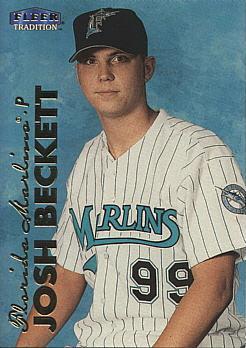
Notable Cards: Josh Beckett and Alfonso Soriano RC. Only RC of Eric Gagne.
Other Notes:
- First ten and last ten cards of '99 Fleer Tradition Update were included in the Millennium Edition factory set.
Subscribe to:
Posts (Atom)



 Posts
Posts

